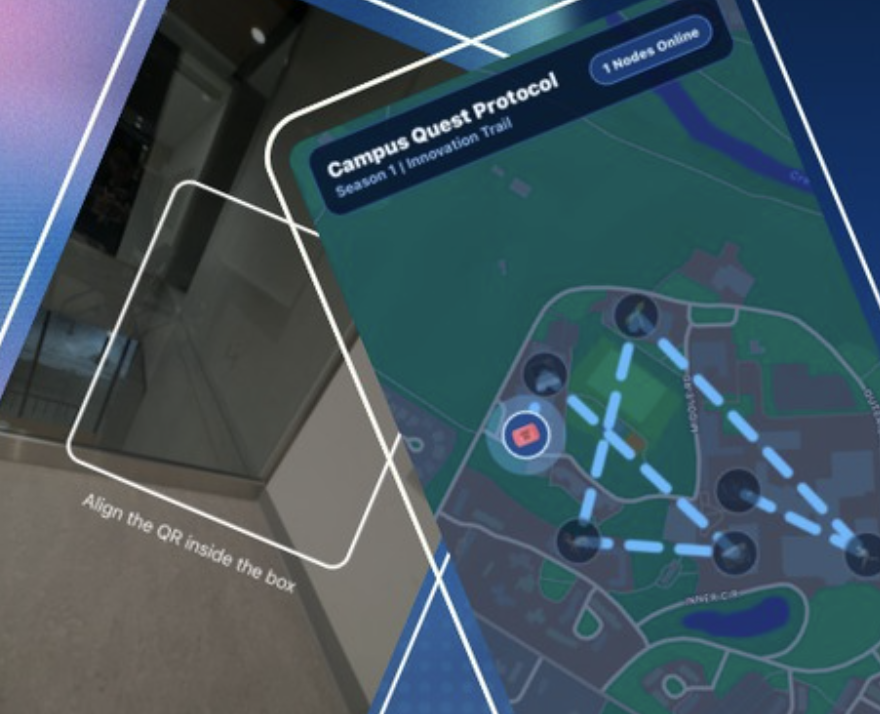
One-line summary: CampusQuest turns your campus into a game: explore events, complete challenges, earn XP, badges, and Solana rewards, connect with clubs, and innovate campus life while having fun.
Core framing: Turning UTM into a Living Innovation Game World. Built at DeerHacks 2026 (36-hour hackathon). Focus: Web3 + Gamification + AR + Community Impact.
Primary source is .mov. If your browser cannot play it reliably, use the direct open/download links above.
Browser support check loading...
If you later export a compressed browser-friendly MP4, place it beside the MOV and wire it as an additional source.
Inspiration
Campus life at UTM often drives one-time event attendance: students show up once and leave with no persistent engagement loop. We wanted ongoing participation to create identity and reputation across clubs.
Problem frame: static events produce one-off attendance; challenge-based progression produces recurring curiosity, cross-club exploration, and verifiable recognition of effort.
What It Does
Student Side
Open app and navigate a milestone-based campus map.
Discover club micro-quests at real campus locations.
Scan QR codes to unlock challenges.
Submit responses for XP and Campus Coins (Solana).
Unlock and equip avatar cosmetics in wardrobe.
Build a verifiable innovation identity over time.
Club Side
Publish custom challenges without high event budget overhead.
Chain challenges across clubs for cross-disciplinary progression.
Track engagement quality and submission performance.
Innovation Chain
Challenge chaining is the differentiator: instead of isolated tasks, students traverse a connected innovation graph across clubs and disciplines.
System effect: discovery, solve, progress, and repeat loops become persistent across campus rather than bounded by one event.
Campus Quest: Turning Campus Life into a Live Game Map

What if campus events felt less like one-time check-ins and more like a game you can keep leveling up in?

Campus Quest turns UTM into a persistent mobile game world where clubs publish real challenges across campus, students scan QR codes, solve creative tasks, and earn XP, avatar cosmetics, and on-chain Solana rewards.
Instead of static event culture, it creates an innovation loop: discover, solve, progress, repeat.

Students can:
- Explore milestone-based map nodes tied to real campus locations
- Complete cross-club innovation quests
- Earn Solana-powered Campus Coins and track reward transactions
- Customize their character through a code-driven wardrobe system

Clubs can:
- Publish and chain challenges into cross-disciplinary paths
- Drive engagement without large event budgets
- Build a more interactive campus culture

We built this at DeerHacks 2026 with an amazing team: Rizul Sharma, Eva Rosati, Daniel Felipe Mena Andrade, and me (Anhad Chawla).

Tech stack:
React Native, Expo, Expo Go, TypeScript, JavaScript, Node.js, Express.js, REST API, MongoDB, Mongoose, Solana, web3.js, Lamports, React Native Maps, Figma, Git/GitHub, Python.

This project pushed us deep into mobile app architecture, behavioral product design, and real blockchain reward systems.
If you're building mobile x Web3 products, I'd love to connect and exchange ideas.

#MobileDevelopment #ReactNative #Expo #Solana #Web3 #Blockchain #Nodejs #MongoDB #TypeScript #SoftwareEngineering #UTM #DeerHacks #HackathonProject